About leadercommunicator blog

What does it take to be a leadercommunicator?

The Grossman Group CEO and communications expert David Grossman shares his insights on the importance of meaningful leadership communication in today’s business climate. With high level tips on engagement and connection, insights into employee motivations and behavior, and firsthand stories from the frontlines of America’s leading companies,

The leadercommunicator blog is instructive, entertaining, and a must-read for leaders, communicators, and leadercommunicators.

Subscribe by Email

Your email:

In the News:


You can also find us here:

Featured in Alltop

Leadership Digital

NSA Speaker Info

Daily Dog

Linked 2 Leadership

Business Management Blogs

NSA Speaker Info

Topics

Current Articles | RSS Feed RSS Feed

The Four Questions Leaders Must Answer During Any Change


4 questionsChances are you’re working today on a change that affects your team.  How you implement that change will impact whether you meet your overall goals. 

Here’s the mistake leaders can’t help but make: they wait to communicate.  Until they have more information.  Until they have “all the answers.”  Until it’s often too late. 

The result is that someone else is doing the talking -- whether they’re right or wrong -- and it’s feeding the grapevine.  Worse yet, what employees then surmise is happening in their minds usually is much worse than the planned change.

Chances are you have information right now that would be valuable to employees and merits communication to them.

Here’s what employees would tell you about their needs during times of change:

  • Employees want to know what you know today and understand when you don’t have all the facts or details.
  • They want to be kept in the loop as plans develop. They want to know what you know when you know it. 
  • They also want to know what information you’re working on figuring out.  When can they expect to get updates?

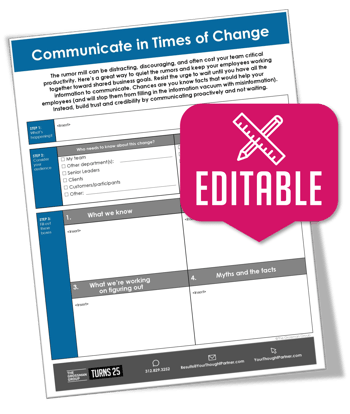
Given that, here’s the outline for any communication about change: 

  • What we know
  • What we don’t know
  • What we’re working on figuring out
  • Myths and the facts (this is about proactively busting myths or misconceptions you’re hearing and correcting any misinformation)

Thinking you’re not ready to communicate?  List possible messages under each topic above and see whether there’s enough information employees would find valuable to merit communication. 

In almost all cases, you’ll have enough information, and begin an important dialogue that will help you minimize the downside of change and maximize the upside.

What are you waiting to communicate that you might need to communicate sooner than you might have thought?

- David Grossman

____

home-can-you-hear-me-now

Comments

I understand the need to keep employees informed and invested through change. What do you do, however, when employees use whatever information you share to put up roadblocks and delay change - or worse yet involve other stakeholders with only part of the picture. I recognize it is a trust issue as well. Yet, how do you build trust when the rumor mill is churning?
Posted @ Thursday, May 24, 2012 10:43 AM by Eliz Greene
The rumor mill fills typically because you're not letting employees know what you know, when you know it.  
 
In the absence of that, employees fill in for themselves, and usually they surmise scenarios that are much worse than what's actually happening (it's human nature).  
 
Additionally, you need to proactively address rumors in your communication head on: we've heard this rumor, here are the facts... 
 
Does this help? 
Posted @ Thursday, May 24, 2012 1:09 PM by David Grossman
It does, or perhaps it would, if the misinformation wasn't intentional. How do you communicate with the "reasonable" people when those with an agenda get their twisted version of the message out almost before you've had a chance?
Posted @ Thursday, May 24, 2012 8:18 PM by Eliz Greene
You need to beat them to the punch and then proactively address myths and misinformation. Reasonable people will listen and understand. Not sure there's much else you can do about others who have their own agenda, and are intentionally causing problems, except feel sorry for them, and their need to do so.
Posted @ Friday, May 25, 2012 8:23 AM by David Grossman
Post Comment
Name
 *
Email
 *
Website (optional)
Comment
 *

Allowed tags: <a> link, <b> bold, <i> italics