

September 22, 2021

Email can be a wonderful tool, if used properly. You likely use email as a communication channel in the workplace even more now that more employees are working remotely, but it’s important to consider its limitations and not overload your employees’ inboxes. Email is typically a form of one-way communication—meaning it does not allow for an immediate exchange of ideas like calls, in-person, or online virtual meetings do. Aside from using email as a logistics and project coordination tool, it’s best used as follow-up to meetings to recap concepts, agreements and gain alignment between groups.
As with all communications, emails must be planned and considered to get the action you want. Estimates show that there will be 319.6 billion emails sent and received globally each day in 2021. If we’re using it more frequently, we may as well be better at it.
Email is most effective to…
- Provide directional, important and timely information
- Share detailed information and data
- Ensure there’s a record of your communication
- Direct the receiver to an online source for more information
- Provide brief status updates
|
|
|
|
Provide one or multiple audiences with a brief status update in the body of a message |
To give bad or negative news |
|
Deliver a longer message or information as an attachment to your intended receivers |
To give complex or lengthy information or instructions |
|
Give timely information consistently to recipient(s) |
When the receiver deserves an opportunity to give immediate feedback or response |
|
Prompt the recipient(s) to view web-based content or other content that’s attached |
When there might be nuance or context that can’t be understood by written words; to express feelings |


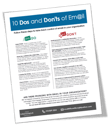
Get the most out of email with the help of this tip sheet. You'll get suggestions anyone can implement to avoid email abuses and fix bad habits. Click here to download, print, and hang in your home or office, and/or share with a colleague.
Tips and Best Practices for Email:
- Make the subject line relevant and meaningful
- Keep messages focused, easy to read and brief
- Don’t put anything in an email you wouldn’t want publicly broadcast
- Indicate if you need a response and provide timing (what and when)
- If it takes more than 2 – 3 emails to bring closure to a topic, make it a voice-to-voice conversation (it’s likely too complex for an email)
- Before you send your email, open your attachments to ensure you’ve attached the right document(s)
- Re-read your email before you send it to check for clarity and relevancy—if it’s not easy to digest, make the necessary edits or consider making a phone call or scheduling a meeting instead
Biggest Email Abuses and Bad Habits:
- Selecting email as the wrong method of communication – this is one of the biggest causes of email overload. Ensure you’re using the best channel for your message with the help of this guide covering the best practices of 21 communication channels.
- Poorly written emails – write your message so it’s simple, clear, and to the point.
- Sending irrelevant information – this is another big cause of email overload. Think about your audience(s) before you hit send – is the information in your email relevant to them? If not, leave them off it.
- Engaging in too much back-and-forth when a phone call would solve the issue – email sometimes doesn’t turn out to be the right vehicle. In those cases, don’t be afraid to pick up the phone to finish the conversation in a more efficient way.
- Hiding behind email for tough conversations – it feels so easy to avoid difficult conversations by sending an email, but research shows that conflict escalates quicker and lasts longer over email. Instead, pick up the phone or schedule meeting.
- No call-to-action – ensure you explain the reason for the email and what you would like your recipient to do as a result of it.
- Using “reply all” improperly – if everyone on the chain doesn’t need to see your response why fill up their inbox?
- CC’ing unnecessarily – the CC field should be used as an FYI, not to take action. CC your manager when you want him or her to know you’ve taken an action.
- Saying something on email you wouldn’t want to read in the newspaper.
When all else fails, keep in mind: Email unto others as you would have them email unto you!
How might you use email more effectively?
—David Grossman
See how being more purposeful when choosing communication channels leads to less clutter and more effective communications with employees. Click below to download your free copy of the eBook—Use the Right Channels to Communicate with Impact: 21 Channel Guide—today.
Tag(s):
Internal Communication
Comments on this post