

March 25, 2026

In my three decades of working with senior leaders, I’ve found the best often rise to meet unprecedented challenges. Yet, today's leadership landscape is much tougher, with the pressure on leaders intensifying in all directions.
Leaders face a perfect storm. The demands on their time, their teams, and their own capacity seem to grow exponentially, while the pressure to deliver results has never been greater.
Chances are, if you’re reading this, you’re feeling it. My guess is you’re doing a lot of things right, but somehow, there’s this nagging sense that you’re still not meeting the moment. Consider the short list: Increasing pressure for shareholder value. The rise of artificial intelligence. Lingering shifts in workplace expectations and the way we work, triggered by a global pandemic. Ongoing economic and political uncertainty around the world.
Recognizing the demands on the leaders we work with, The Grossman Group partnered with The Harris Poll to better understand what employees need most from leaders now.
What Exceptional Modern Leadership Looks Like
Our research found that employees have a very clear idea of what exceptional is – what Modern Leadership should look and feel like today.
Our study surveyed more than 2,206 employed Americans. The majority of employees graded their leaders as simply “good,” and pointed to opportunities for leaders to elevate their impact and make a real difference in engagement and motivation. A much smaller group put their leaders in the “exceptional” category, and 16% of employees said their leaders still used outdated, command-and-control leadership styles, leading to burnout, exhaustion, and disconnection.
Employees went on to define the specific actions that they believe sum up exceptional Modern Leadership. That will be a central focus of this post. But first, here’s a look at the overall report card:
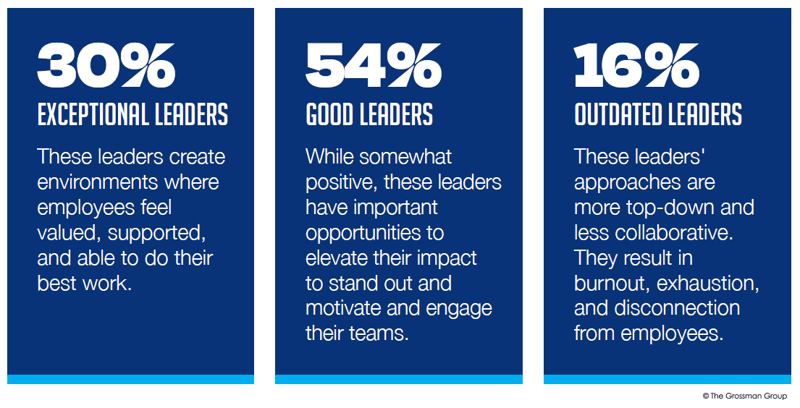
Of the 2,206 employees surveyed, the leader grades lined up this way:
- 54% of Leaders Rated “Good.” While there are some positives to consider, overall, these leaders need to elevate their impact. As employees repeatedly signaled, “good” is definitely not good enough anymore.
- 30% of Leaders Rated “Exceptional.” These leaders create environments where employees feel valued, supported, and able to do their best work.
- 16% of Leaders Rated “Outdated.” These leaders’ approaches result in burnout, exhaustion, and disconnection.
As we share more details here, you’ll see the themes of what it takes to be exceptional. It probably won’t surprise you that the current workforce – fueled by a new generation looking for new kinds of leaders – craves more connection, meaning, and support than ever before. There’s also no question that all employees, across generations, appreciate leaders open to greater flexibility and autonomy. Achieving all that’s asked of leaders is no small feat. At times, it may even feel like there’s a personal cost, in your own stress levels, health impacts, and sense of well-being.
After all, the new business realities require an entirely different kind of leadership approach than what many of today’s leaders experienced themselves. I think of my own career, including my time working part-time jobs in college and my early years in corporate communications. In those junior roles, there was little talk of my needs as an employee.
My opinion was not often solicited. The whole idea of feeling heard and respected wasn’t even part of the wider conversation. The exceptional leaders at that time asked for my perspective, and I felt seen, heard, and appreciated by them, but they were few and far between. More often, I just saw commands handed down.
While the culture has gradually changed, lingering effects of the old archetype remain, and plenty of leaders still try to emulate a command-and-control approach. Especially when the inevitable pain points inside a business emerge, poor leaders tend to turn up the heat, thinking pressure or criticism will motivate. In our survey alone, 16% of leaders were still placed in this command-and-control leadership style category. Yet, when we and others ask employees, we get the same answer. The old approach isn’t just outdated; it’s actively harmful to both people and organizations.
To respond to the new needs, employees ask leaders to bring something much different to the modern workforce. That work isn’t always easy, but I believe the path is absolutely worth it, and more achievable and fulfilling than it may seem.
In many ways, the task ahead for leaders is about striking the right balance. Balance technological advancements, such as artificial intelligence, with human connection. Balance productivity with well-being and reasonable boundaries. Balance business results while also promoting personal growth for employees.
What Makes a Modern Leader: 6 Key Differentiators
As our research with The Harris Poll uncovered, the short list of the character traits and habits that the workforce most admires in modern leaders includes six main leadership differentiators:
The 6 main differentiators that set apart exceptional modern leaders:
- Lead with gratitude
- Listen and empathize
- Foster an inclusive culture
- Communicate with context
- Connect strategy to employee growth
- Enable employees to meet the moment
These research findings resonated with me based on all the work we’ve done with clients in recent years.
Why Moving from Good to Great Matters for Modern Leaders
At first glance, it may feel encouraging that many employees rated their leaders as “good.” So, what’s the problem? As we’ve pointed out, good is definitely not good enough in Modern Leadership. As Jim Collins’ famous Good to Great business management book argued, moving from good to great is everything. Many of the companies Collins profiled in 2001 would have failed in the long run had they not taken action to pursue excellence at that time.
The same is true for modern leaders. When we don’t push ourselves beyond the status quo, we limit our own potential, and that of our teams. And if we don’t push ourselves to manage better, we can’t expect our teams to be better either.
I’ve seen this in our own work and the work of our clients. Many of the business leaders who contributed to this book have experienced it, too. I think back on the story shared by one of the HR leaders who contributed to this book. The leader at CareRX Canada shared that the organization tracks employee retention monthly. When retention seriously slides, and new leaders with better management skills are brought in, the results have been clear: retention improves, employees feel supported, and engagement goes up. This is just one example that shows that the way leaders lead truly matters.
The practices we lay out in more detail in this book serve as a blueprint for the kind of actions that make a lasting difference. Employees crave modern leaders who are up to the task. Let us help you get on track with the transformative heart work of Modern Leadership.

6 Forces Driving Change for Modern Leaders
No doubt, we're living in an era of unprecedented change and complexity. A number of forces have accelerated the need for Modern Leadership:
1. Workplace Transformation
The workplace upheaval brought on by the 2020 pandemic revealed a profound shift in what employees seek from their leaders and organizations. When traditional playbooks fell short during the global crisis, successful leaders discovered the power of authenticity and empathy. One executive shared with me, "We had no roadmap – we simply had to be human." This insight became a guiding principle for leadership moving forward.
Today's employees seek more than competitive compensation or traditional benefits. They want leaders who demonstrate genuine understanding of their challenges, celebrate their contributions, and create opportunities for growth. This isn’t about being “soft” as leaders. In fact, employees respect high expectations and welcome challenges. Rather, employees want to see meaningful flexibility in how work happens, an understanding of how daily tasks connect to organizational purpose, and environments where career development is prioritized.
As leaders, we must recognize this isn't a temporary adjustment but a fundamental transformation in how we engage and retain talent. Our role is to create cultures where team members feel truly valued, empowered to contribute meaningfully, and supported in their professional journey. The most successful leaders balance empathy with execution.
2. Mental Health Awareness and Workplace Wellness
The pandemic highlighted the critical importance of supporting employee well-being. Remote work has blurred traditional boundaries, while ongoing uncertainty contributes to stress and burnout. Forward-thinking leaders recognize that creating psychologically safe environments where teams can openly discuss challenges isn't just compassionate – it's essential for employee performance. And check-ins aren’t just about work; they also focus – in part or exclusively at times – on how the employee is managing their overall health and well-being.
3. Generational Expectations
Millennials and Gen Z, who now make up the majority of our workforce, are fundamentally reshaping leadership expectations. These generations seek more than just career advancement – they want work that aligns with their personal values and contributes to a better world. These team members value continuous feedback and growth opportunities, preferring regular coaching conversations over annual reviews. They expect leaders to share the context behind decisions and welcome their input. Most importantly, they seek leaders who demonstrate self-awareness, acknowledge their own growth areas, and create a culture where authentic dialogue thrives.
For leaders, this means moving beyond traditional hierarchical relationships to become more accessible mentors and coaches. We must invest time in understanding individual aspirations, provide growth opportunities, and create clear connections between daily work and the larger organizational purpose.
4. Social Justice Awareness
The global focus on equity has fundamentally changed what employees expect. Our teams want to see meaningful action behind organizational statements. They also look for leaders who actively seek out diverse perspectives, address unconscious bias, and create environments where everyone can bring their evolved selves to work.
This requires leaders to examine their own assumptions and blind spots while building cultural competence. Modern leaders create forums for honest dialogue about challenging topics. Effective leaders recognize that inclusion isn't a program – it's a mindset that shapes every decision, from hiring and development to how we run meetings and recognize contributions.
5. Economic Uncertainty
Market volatility and economic pressures create layers of stress for our teams that extend far beyond the workplace. Employees worry about job security, retirement savings, and providing for their families. Many face complex financial pressures, supporting adult children or aging parents. The need then is regular, transparent updates about business performance and organizational health, while creating opportunities for open dialogue about economic concerns. Modern leaders ensure teams know about available financial wellness resources and benefits. They also focus on career development to enhance job security. Most importantly, they recognize and reward contributions consistently, showing employees they're valued even in challenging times.
6. AI and Automation Anxiety
The acceleration of artificial intelligence and automation creates natural concerns about job security and workplace transformation. Employees question their future roles, wonder which skills they'll need, and seek clarity about how their work will evolve.
As leaders, we must help our teams navigate this transition thoughtfully through transparent communication. This means working with each team member to create development plans that focus on future-ready skills, while showing how AI and automation can enhance rather than replace human work. Most importantly, we must continually reinforce the enduring value of uniquely human skills like creativity, emotional intelligence, and complex problem-solving.
A Deep Dive into The Six Differentiators of Exceptional Modern Leadership
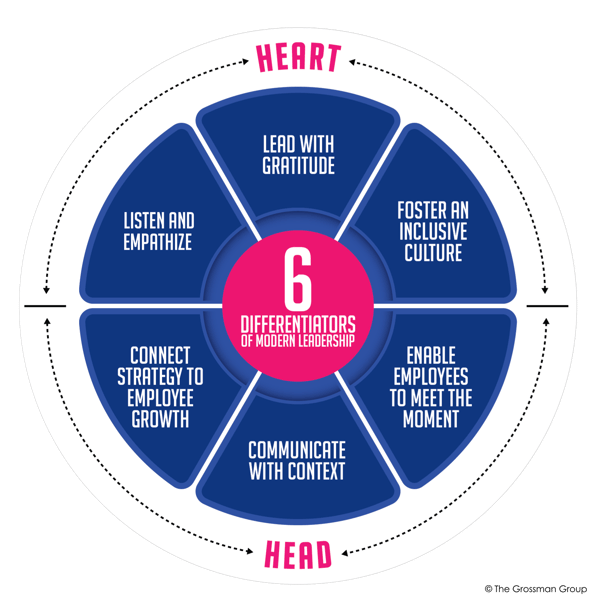
Through detailed factor analysis, the six key differentiators provide leaders with a clear roadmap for becoming exceptional. Let’s dive into why these differentiators matter so much for modern leaders.
1. Lead with Gratitude
Exceptional leaders show 8.2 times better performance in expressing genuine appreciation compared to outdated leaders. They make gratitude a daily practice, not an occasional gesture.
What It Means:
Senior Leadership....
- Shows gratitude to employees, acknowledging hard work and effort
- Creates a culture where employees want to come to work and be at their best
- Promotes the importance of employees focusing on personal well-being, including both mental and physical well-being
Why It Matters:
- 54% of employees working under exceptional leaders strongly agree that their leaders show gratitude and acknowledge hard work. Only 5% of those under outdated leaders report the same. This is the largest performance gap among all leadership differentiators.
2. Listen and Empathize
The research shows exceptional leaders are 6.9 times better than outdated leaders at demonstrating genuine empathy and understanding. They create safe spaces for feedback and vulnerability.
What It Means:
Senior Leadership....
- Listens to understand
- Fosters a sense of unity across departments and teams – recognizing that everyone is working towards a common goal
- Shows empathy in how they engage with employees
- Creates an environment where individuals feel safe to share feedback, take risks, and be vulnerable in front of one another
- Helps employees feel valued and understood
Why It Matters:
- When working for exceptional leaders, 51% of employees strongly agree that their leaders make an effort to listen to understand; 48% say their leaders show empathy (compared to 21% under good leaders); and 47% say their leaders create environments where employees feel valued and understood (compared to 6% under outdated leaders).
3. Foster an Inclusive Culture
Creating an environment where employees want to come to work and be at their best is a hallmark of exceptional leadership, with these leaders performing 7.09 times better than outdated leaders in this area.
What it Means:
Senior Leadership....
- Works to understand the unique backgrounds and experiences of employees to improve culture
- Leads by example and is accountable for their actions
- Demonstrates a focus on building trust with employees
- Finds space for creativity and injects it into everyday activities
Why It Matters:
- Under exceptional leaders, 45% of employees strongly agree that senior leadership creates an environment where individuals feel safe to share feedback, take risks, and be vulnerable in front of one another. This compares to just 7% of employees reporting those feelings when working for an outdated leader.
4. Communicate with Context:
Top leaders are 7.28 times more effective than outdated leaders at adjusting their communication to meet employee needs. They're intentional about consistently communicating strategy and ensuring transparency.
What it Means:
Senior Leadership....
- Calibrates their communication to meet employee needs
- Communicates with transparency
- Acts on employee feedback
Why It Matters:
- 46% of employees under exceptional leaders strongly agree that their leaders communicate with transparency, and 44% report intentional and consistent communication of company strategy.
- Exceptional leaders clearly communicate how ideas will be used, or not, and why. By contrast, leaders who ask for employee feedback and never act on it leave employees frustrated and disengaged.
5. Connect Strategy to Employee Growth
Top leaders excel at helping employees understand how they fit into the company's long-term vision, performing 6.36 times better than outdated leaders in this area.
What It Means:
Senior Leadership....
- Helps employees know how they fit in the company’s long-term talent strategy
- Is intentional about consistently communicating company strategy
- Involves employees in company change to make it as easy as possible
- Ensures communication is focused on helping employees understand why change is needed and how it will help the organization evolve
- Demonstrates that people are the greatest investment and finds traditional or creative ways to support employee development
Why It Matters:
- 46% of employees working for exceptional leaders strongly agree that senior leaders help employees know how they fit into the company’s long-term talent strategy. This compares to just 5% for employees under outdated leaders.
6. Enable Employees to Meet the Moment
Exceptional leaders are 8.04 times more likely to actively support employee development and provide resources for growth compared to outdated leaders.
What it Means:
Senior Leadership....
- Actively exposes individuals to best practices and bold ideas to meet the moment of today
- Understands the work that needs to be done and selects the right people for those roles
- Encourages collaboration across the organization and creates avenues for this to occur
- Is able to successfully deploy new tech that positively impacts workload and culture
- Ensures employees understand how their work connects to the purpose of the organization
Why It Matters:
-
45% of employees working under exceptional leaders strongly agree their leaders demonstrate that people are the greatest investment and find traditional or creative ways to support employee development. Only 4% of employees working for outdated leaders report this.
The Modern Leader’s Heart-Head Leadership Balance
One of the most fascinating insights from the research is that while both "heart" and "head" leadership traits matter, heart-centered leadership qualities have an edge in driving exceptional results. As the following chart highlights, nine out of the top 10 traits of exceptional leaders are heart-focused. Showing gratitude for employees, followed by senior leaders listening to understand, were the top two traits of exceptional leaders.
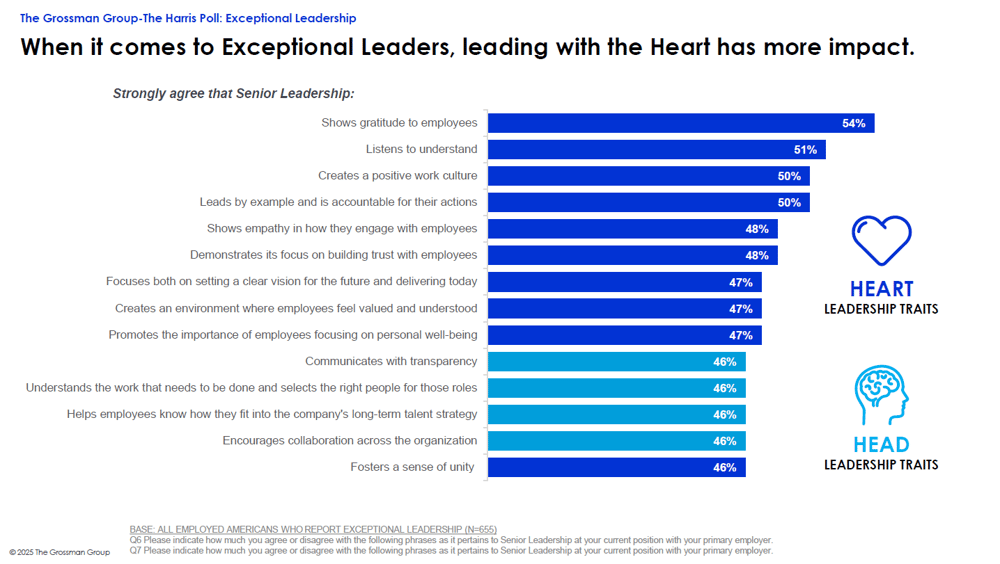
Our takeaway from this is that the best leaders know how to lead with both their heart and their head, finding many opportunities to integrate both elements into their leadership style.
The Costs of Outdated Leadership for Modern Leaders
The research also provides an important warning about the costs of Outdated Leadership approaches. Employees feel lousy under outdated leaders. As we have highlighted, employees frequently report feeling burned out, exhausted, overwhelmed, bored, and under a constant sense of pressure when working for outdated leaders.
Employees feel outdated leaders have the wrong priorities, strongly agreeing with the following statements:
- 38% say leadership is more concerned with external stakeholders than employee well-being
- 37% report that leadership is absent in helping build a positive workplace culture
- 32% feel leadership focuses on short-term wins over long-term success
The gap between Exceptional and Outdated Leadership is particularly stark in three areas:
- Demonstrating investment in people, finding traditional or creative ways to support employee development (11.3 times difference)
- Showing gratitude, acknowledging hard work and effort (10.8 times difference)
- Demonstrates its focus on building trust with employees (9.6 times difference)
Where We Go from Here
What we learn from this research is that exceptional Modern Leadership is strongly felt by employees. They know a great leader when they’re fortunate enough to work for one. Employees also paint a clear picture of how leaders can become exceptional. What’s most encouraging about these leadership differentiators is how specific – and doable – they are in practice.
Striving to implement these approaches is well worth the effort. Our research shows that making the shift from good to exceptional creates measurable improvements in employee engagement, reduces burnout, and drives organizational success. Our employees are asking for better from modern leaders. Now’s the time for all of us to meet the moment.
The leadership gap in your organization isn't where you think it is.
The Heart Work of Modern Leadership gives you the research, the framework, and the practical tools to close it – and to make the case to your C-suite for why it matters now.
Endorsed by CCOs, communications leaders, and CEOs across Fortune 1000 companies – including Linda Rutherford, Executive Advisor, Southwest Airlines Company (former CCO), Jon Harris (Chief Communications Officer, Conagra Brands), and Aaron Radelet (Chief Corporate Affairs Officer, Acrisure) – this is the book your leadership team needs to read together.
Where do you have the greatest opportunity to move from “good” to “exceptional” – and what will you do differently starting now?
—David Grossman
Order The Heart Work of Modern Leadership today – available at Amazon on Kindle and print!
Comments on this post